|
|

Murder, Mystery, and Mayhem Await as You Rediscover the Dark Days of Johnson City's Illusive Prohibition Era!!
| Who are the ghosts of the former John Sevier Hotel which is host to many tragic deaths and at least one suicide? Discover who walks the halls of Johnson City's own television station. Learn about the local and regional area activities of |
| the most notorious gangsters of all time. The Little Chicago GhostWalk of downtown Johnson City brings you much in the way of early 20th century life with the history and origins of NASCAR, bootlegging, and moonshine running. Find out more about | 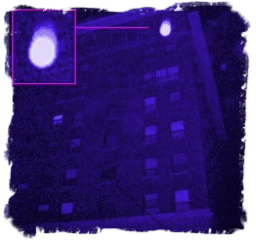 |
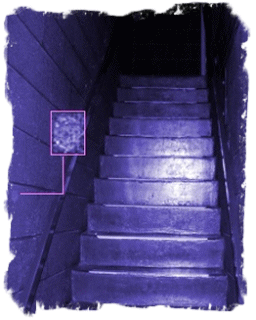 | Johnson City's only mass murder and how the truth of this tragic affair, associated with the gangster period of the 1920s resurfaced due to the efforts of our recent investigations. You will even learn about underground tunnels and how they were used by Al Capone and his band of mercenaries while touring just one town within what he called the "Appalachian |
| Wing" of his illegal whiskey dealing operations. Newly revised and updated, you will learn the details of Johnson City's rich history and love affair with the train. When it comes to our Johnson City Ghost Tour, we encourage all of our guests to be prepared for ANYTHING!! It is well-named "The Little Chicago". | 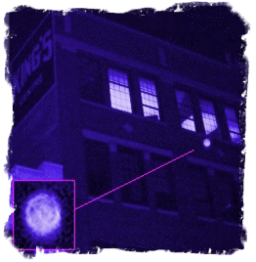 |
The Johnson City Little Chicago Ghost Tour Departs From:
Freiberg's, 203 East Main Street, Johnson City 37604
| Appalachian GhostWalks' "Johnson City Little Chicago GhostWalk" Lantern-Led Tour operates year-round by request. Advance reservations online with a minimum of two participants in your party are required to reserve as follows... |
March through October  RESERVE NOW RESERVE NOW
Evening Lantern-Led Little Chicago Ghost Tours Begin at 8:30 PM DST |
November through February RESERVE NOW
Evening Lantern-Led Little Chicago Ghost Tours Begin at 6 PM EST |
| Tours and dates are booked on a first come first served basis so it's a good idea to reserve your date as soon as possible. Keep in mind that if you book a tour and need to change the date, or even postpone your tour indefintely, you may do so as often as needed without limits, or change fees for up to one year from the date of purchase. By reserving your tour in advance, you're worry free knowing you will have the tour and date of choice for you and your travel companion, family, or tour group. |
|
Here Are a Few Reviews From Past Tour Guests
Little Chicago Tour (Johnson City GhostWalk) last night was awesome!! Despite very frigid temperatures is was a great time with great storytelling! - Dawn Melton

One of the Best! Johnson City TN Little Chicago tour. Was a wonderful mix of history, information and paranormal - personal and reported. Stacey is very engaging and extremely knowledgeable. Thoroughly enjoyed every minute! Whether you are a believer or not, Stacey is genuine in his presentation. - Ann G.
My wife and I along with my two teenage Grandchildren went on the Johnson City GhostWalk. We found this tour to be most interesting. I will say... I was a skeptic, but I am not NOW. Wow, Thanks for the experience. - Winston Nixon
Johnson City Little Chicago GhostWalk - FANTASTIC!!!! We had a wonderful eerie time!! The stories were surprising and shocking! Who knew there was such a history hidden in a tiny Tennessee town? Our guide Stacey, was wonderful and funny! Close to 3 hours and worth every nickel. We hope to take the other tours they offer. We've taken alot of Ghost tours across the country, Gettysburg for one this tour is one of the best! I promise, you'll have a great time! - TripAdvisor - Extraordinary3393
These are just a few of the many kind words expressed by our past guests. Read hundreds of other testimonials on the Guest Review page of our site. Many thanks to our wonderful past guests who we have toured with for more than twenty years. We appreciate you sending us your gracious feedback. We hope to see you again soon for another simply SPOOK-tacular good time!!! |

A Brief History of This Very Haunted and Historic Town
| Johnson City is a city in Washington, Carter, and Sullivan counties in the U.S. state of Tennessee, mostly in Washington County. As of the 2020 United States census, the population was 71,046, making it the eighth-most populous city in Tennessee. Johnson City is the principal city of the Johnson City Metropolitan Statistical Area, which consists of Carter, Unicoi, and Washington counties and had a population of 207,285 as of 2020. The MSA is also a component of the Tri-Cities region. This CSA is the fifth-largest in Tennessee, with a population of 514,899 as of 2020. |
| HISTORY: William Bean, traditionally recognized as Tennessee's first white settler, built his cabin along Boone's Creek near Johnson City in 1769. In the 1780s, Colonel John Tipton (1730–1813) established a farm (now the Tipton-Haynes State Historic Site) just outside what is now Johnson City. During the State of Franklin movement, Tipton was a leader of the loyalist faction, residents of the region who wanted to remain part of North Carolina rather than form a separate state. In February 1788, an armed engagement took place at Tipton's farm between Tipton and his men and the forces led by John Sevier, the leader of the Franklin faction. |
| Founded in 1856 by Henry Johnson as a railroad station called "Johnson's Depot", Johnson City became a major rail hub for the Southeast, as three railway lines crossed in the downtown area. In the late 19th and early 20th centuries, Johnson City served as headquarters for the narrow gauge East Tennessee and Western North Carolina Railroad (the ET&WNC, nicknamed "Tweetsie") and the standard gauge Clinchfield Railroad. Both rail systems featured excursion trips through scenic portions of the Blue Ridge Mountains and were engineering marvels of railway construction. The Southern Railway (now Norfolk Southern) also passes through the city. |
| During the American Civil War, before it was formally incorporated in 1869, the name of the town was briefly changed to "Haynesville" in honor of Confederate Senator Landon Carter Haynes. Henry Johnson's name was quickly restored following the war, with Johnson elected as the city's first mayor on January 3, 1870. The town grew rapidly from 1870 until 1890 as railroad and mining interests flourished. However, the national depression of 1893, which caused many railway failures (including the Charleston, Cincinnati and Chicago Railroad or "3-Cs", a predecessor of the Clinchfield) and resulting financial panic, halted Johnson City's boom town momentum. |
| In 1901, the Mountain Branch of the National Home for Disabled Volunteer Soldiers (now the U.S. Veterans Affairs Medical Center and National Cemetery), Mountain Home, Tennessee was created by an act of Congress introduced by Walter P. Brownlow. Construction on this 450-acre (1.8 km2) campus, which was designed to serve disabled Civil War veterans, was completed in 1903 at a cost of $3 million. Before the completion of this facility, the assessed value of the entire town was listed at $750,000. The East Tennessee State Normal School was authorized in 1911 and the new college campus directly across from the National Soldiers Home. Johnson City began growing rapidly and became the fifth-largest city in Tennessee by 1930. |
| Together with neighboring Bristol, Johnson City was a hotbed for old-time music. It hosted noteworthy Columbia Records recording sessions in 1928 known as the Johnson City Sessions. Native son "Fiddlin' Charlie" Bowman became a national recording star via these sessions. The Fountain Square area in downtown featured a host of local and traveling street entertainers including Blind Lemon Jefferson. |
| During the 1920s and the Prohibition era, Johnson City's ties to the bootlegging activity of the Appalachian Mountains earned the city the nickname of "Little Chicago". Stories persist that the town was one of several distribution centers for Chicago gang boss Al Capone during Prohibition. Capone had a well-organized distribution network within the southern United States for alcohol smuggling; it shipped his products from the mountain distillers to northern cities. Capone was, according to local lore, a part-time resident of Montrose Court, a luxury apartment complex now listed on the National Register of Historic Places. |
| For many years, the city had a municipal "privilege tax" on carnival shows, in an attempt to dissuade traveling circuses and other transient entertainment businesses from doing business in town. The use of drums by merchants to draw attention to their goods is prohibited. Title Six, Section 106 of the city's municipal code, the so-called "Barney Fife" ordinance, empowers the city's police force to draft into involuntary service as many of the town's citizens as necessary to aid police in making arrests and in preventing or quelling any riot, unlawful assembly or breach of peace. |
| GEOGRAPHY: Johnson City is in northeastern Washington County, with smaller parts extending north into Sullivan County and east into Carter County. Johnson City shares a contiguous southeastern border with Elizabethton. Johnson City also shares a small contiguous border with Kingsport to the far north along I-26 and a slightly longer one with Bluff City to the northeast along US 11E. According to the United States Census Bureau, the city has an area of 43.3 square miles (112.1 km2), of which 42.9 square miles (111.2 km2) is land and 0.3 square miles (0.8 km2), or 0.75 percent, is water. |
| Buffalo Mountain, a ridge over 2,700 feet (820 m) high, is a city park on the south side of town. The Watauga River arm of Boone Lake, a Tennessee Valley Authority reservoir, is partly within the city limits. Johnson City has a humid subtropical climate (Köppen Cfa), with warm summers and cool winters. Temperatures in Johnson City are moderated somewhat by its elevation and proximity to the Appalachian Mountains. Precipitation is abundant, with an average of 45.22 in (1,149 mm). Summer is typically the wettest part of the year, while early autumn is considerably drier. Snowfall is moderate and sporadic, with an average of 15.6 in (40 cm). |
|

|
|